All life on Earth — including ours — depends on the delicate balance of our planet’s systems: the geosphere, biosphere, cryosphere, hydrosphere, and atmosphere. This balance is disturbed.
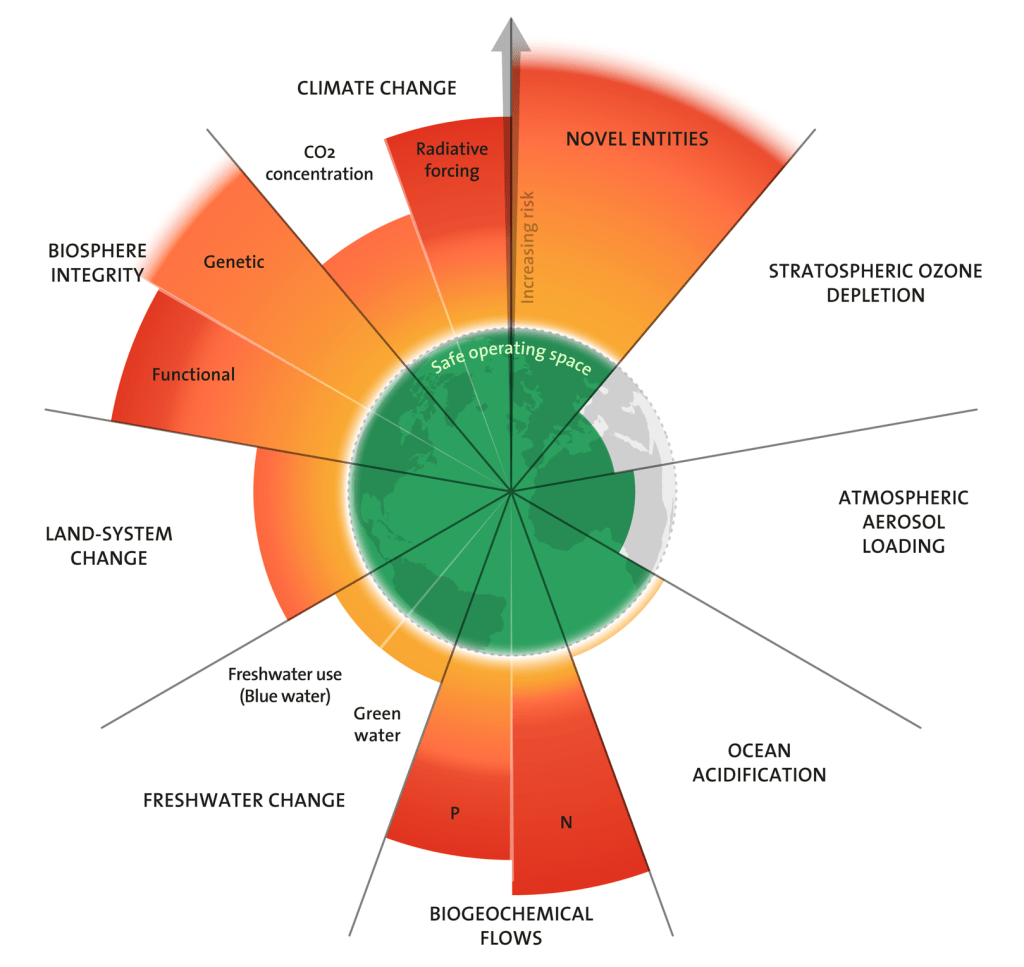
The Planetary Boundaries framework identifies the critical limits of human impact on these systems. If we push past these boundaries, Earth may lose its ability to self-regulate — threatening the stability that allowed human civilization to flourish during the Holocene.
🚨 But here’s the stark reality: we are already crossing those boundaries. Driven largely by industrialised societies since the Industrial Revolution, human activity is now the dominant force reshaping the global environment. And once certain thresholds are crossed, there may be no way back. The consequences could be abrupt, irreversible, and catastrophic — on a continental or even planetary scale.
One alarming threat is from novel entities, such as plastics and other man-made chemicals. These pollutants are not only toxic to ecosystems and human health, but they may also be disrupting the Earth system itself in ways we are only beginning to understand.
🛑 This is not just about the environment — it’s about our future survival. The interdependence of all planetary boundaries means we cannot afford to address one crisis in isolation. We must act urgently and collectively to stop the slide toward irreversible damage. link
Publications
Planetary Health Check 2025 report
Mapping the chemical complexity of plastics
Monclús, L., Arp, H.P.H., Groh, K.J. et al. Mapping the chemical complexity of plastics. Nature 643, 349–355 (2025). https://doi.org/10.1038/s41586-025-09184-8
Abstract Plastic pollution is a pervasive and growing global problem1,2,3,4. Chemicals in plastics are often not sufficiently considered in the overall strategy to prevent and mitigate the impacts of plastics on human health, the environment and circular economy5,6,7. Here we present an inventory of 16,325 known plastic chemicals with a focus on their properties, presence in plastic and hazards. We find that diverse chemical structures serve a small set of functions, including 5,776 additives, 3,498 processing aids, 1,975 starting substances and 1,788 non-intentionally added substances. Using a hazard-based approach, we identify more than 4,200 chemicals of concern, which are persistent, bioaccumulative, mobile or toxic. We also determine 15 priority groups of chemicals, for which more than 40% of their members are of concern. Finally, we examine data gaps regarding the basic properties, hazards, uses and exposure potential of plastic chemicals. Our work maps the chemical landscape of plastics and contributes to setting the baseline for a transition towards safer and more sustainable materials and products. We propose that removing known chemicals of concern, disclosing the chemical composition and simplifying the formulation of plastics can provide pathways towards this goal.
2025 May – Plastics: Exposing Their Climate Impacts, What we know, what need to know, & recommendations for research and policy
This is the first report to comprehensively assess the existing peer-reviewed data on the climate impacts of plastics. The report analyzes existing peer-reviewed data, identifies critical data gaps, lays out a roadmap for continued research, and recommends policies and actions to support that research and to include plastics’ climate impacts in relevant models, scenarios, accounting, and analyses.
The report is authored by leading experts from The Plastics and Climate Project, Holly Kaufman, Senior Fellow at the World Resources Institute, Dr. Xia (Alice) Zhu, a Banting Postdoctoral Fellow at the Department of Ocean Sciences, Memorial University of Newfoundland), and the Environmental Law Institute (Cecilia Diedrich, Staff Attorney, and Dr. John Doherty, Science and Policy Analyst), with key input from the Monterey Bay Aquarium and Dr. Karen Raubenheimer, University of Wollongong, Australia. The report is a non-technical summary of The Project’s peer-reviewed paper, “The knowns and unknowns in our understanding of how plastics impact climate change: A systematic review,” published in April 2025 in Frontiers of Environmental Science.
Read the full report | Read the executive summary | Read the Frontiers in Science paper
Patricia Villarrubia-Gómez, Bethanie Carney Almroth, Marcus Eriksen, Morten Ryberg, Sarah E. Cornell
Summary
Plastics are an international governance priority because of extensive and resource-intensive production, uncontrolled environmental releases, and failure to control the chemicals within the materials. We examine the evidence that plastics have exceeded the planetary safe operating space, discussing how plastics pollution affects multiple Earth system processes along the impact pathway from resource extraction and production to release to environmental fate and impacts. Multiple lines of evidence capture the complex reality of these novel entities; a single planetary boundary quantification would be detrimental. We demonstrate causal links between plastics and other environmental problems, exacerbating the consequences of breaching other planetary boundaries. We propose biophysically defined control variables for the planetary boundaries framework as a way to measure, monitor, and mitigate global plastics pollution. We call for urgent action, recognizing plastics pollution not only as a waste management problem but as an integrative part of climate change, biodiversity, and natural-resource-use policy.
Videos
2024 Exceeding Earth’s Safe Limits with Johan Rockström
Johan Rockström | Planetary boundaries: scientific advances | Frontiers Forum Live 2023
Opening keynote: Johan Rockström – Safe landing within Planetary Boundaries – Day 1 | GTF 2023
The Planetary Boundaries and what they mean for the Future of Humanity
What are the planetary boundaries? | Mongabay Explains
Cascading Interactions Between Tipping Elements in the Anthropocene Earth System – Jonathan Donges, co-leader of the FutureLab on Earth Resilience in the Anthropocene (www.pik-potsdam.de/earthresilience) at the Potsdam Institute for Climate Impact Research
MOOC Planetary Boundaries and Human Opportunities Link
Publications
2024 March – Report by PlastChem State of the science on plastic chemicals -Identifying and addressing chemicals and polymers of concern
2024 – The planetary commons: A new paradigm for safeguarding Earth-regulating systems in the Anthropocene
2023 – Earth beyond six of nine planetary boundaries link
2023 – Conflicts of Interest in the Assessment of Chemicals, Waste, and Pollution link
2023 – UNEP Chemicals in Plastics – A Technical Report link
2023 – United Nations Office for Disaster Risk Reduction Thematic Study: Planetary Boundaries link
2022 – Outside the Safe Operating Space of the Planetary Boundary for Novel Entities link
2022 – Plastics Pollution and the Planetary Boundaries framework link
2021 – Weathering Plastics as a Planetary Boundary Threat: Exposure, Fate, and Hazards link
2020 – Reaching new heights in plastic pollution—preliminary findings of microplastics on Mount Everest link
2019 – Environmental Deterioration of Biodegradable, Oxo-Biodegradable, Compostable, and Conventional Plastic Carrier Bags in the Sea, Soil, and Open-Air Over a 3-Year Period link
2019 – UNEP Global Chemicals Outlook II: From Legacies to Innovative Solutions link
2018 – Development of a life-cycle impact assessment methodology linked to the Planetary Boundaries framework link
2018 – Marine Plastic Pollution as a Planetary Boundary Threat – The Drifting Piece in the Sustainability Puzzle link
2018 – Synthetic polymer contamination in bottled water link
2017- Synthetic chemicals as agents of global change link
2016 – Sources, Fate and Effects of Microplastics in the Marine Environment: Part 2 of a Global Assessment link
2015 – Planetary boundaries: Guiding human development on a changing planet link
2015 – Exploring the planetary boundary for chemical pollution link
2014 – Identifying Chemicals That Are Planetary Boundary Threats link
2013 – Chemical Footprint: A Methodological Framework for Bridging Life Cycle Assessment and Planetary Boundaries for Chemical Pollution: Chemical Footprint Methodology for Aquatic Ecosystems link
2009 – A safe operating space for humanity – Identifying and quantifying planetary boundaries that must not be transgressed could help prevent human activities from causing unacceptable environmental change, argue Johan Rockström and colleagues. link
 International Waste Platform